The Next 20 Years Will Break the Illusions of an Entire Generation
The next bear market will not just destroy portfolios.
It will destroy illusions.
For years you were told that markets always recover quickly, that technology automatically creates prosperity, and that politicians ultimately protect you.
All of that was a lie.
The cost of living will keep rising while your purchasing power disappears. Entire sectors will automate faster than you can adapt. Millions will lose jobs that will never come back. Not because companies are evil — because profit and share price are all that matters. When a machine does your job cheaper and faster, you are gone. That is not a prediction. That is already happening.
The Next 20 Years Will Break the Illusions of an Entire Generation
At the same time, AI will not only reshape the economy. It will reshape warfare. Nations are spending billions on autonomous systems and algorithmic targeting. The arms race is no longer nuclear. It is computational. And nobody is asking your permission.
Then comes the deeper transformation — the one nobody wants to talk about.
You are already a vassal and you don't know it yet.
A child absorbed by Roblox. A teenager shaped by TikTok. Adults guided by algorithmic feeds that tell them what to think, what to buy, what to fear. The same dynamic will scale to finance, employment, and governance. You will not notice it happening until it is too late to resist.
The risk is not that machines become conscious. The risk is that you become passive.
Every time hope returns, reality will get worse. Every recovery will feel like the old world coming back. It won't. Politicians will keep telling you it will. They won't stop lying until you stop listening.
Trust will collapse. Institutions will fall. And an entire generation will arrive at the same unbearable question:
Will our children have a better future than we did?
No. They won't. Not if you do nothing.
You were lied to. By markets. By politicians. By institutions. The next 20 years will prove it.
 Alex Vieira
Alex Vieira Called PayPal's Crash at $300. Now He's Selling Robinhood at $150 Forecasting a 26-Year Bear Market.
The Structural Crisis Behind the 26-Year Bear Market
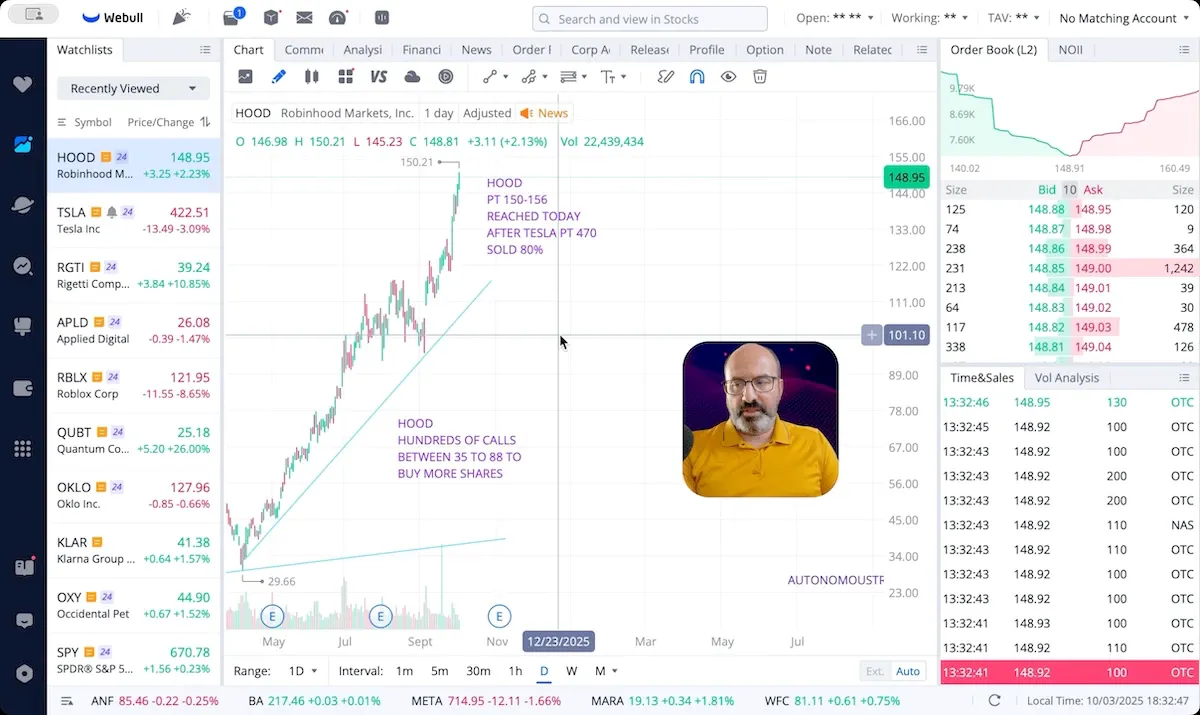
When I sold Robinhood at $150, it was not about a single stock.
It was a warning about everything.
The same framework that called PayPal's collapse at $300 — before it lost the majority of its value — is now reading the entire market. And what it shows is not a correction. It is a structural unraveling that has been building for years under zero interest rates, speculative excess, and narratives that were never backed by durable cash flows.
The next bear market will not erase wealth temporarily. It will expose what was never real to begin with.
Robinhood became the symbol of the speculative era. Retail platforms, meme stocks, narrative-driven valuations — built on liquidity, not reality. Symbols mark turning points. This is the turning point.
This Is Not a Recession
What is coming does not resemble previous downturns.
This is a prolonged structural reset. Rising cost of living. Accelerating automation. Geopolitical AI and military competition that redirects trillions away from social stability. Corporations choosing algorithmic efficiency over human employment because shareholders demand it.
Technological acceleration has outpaced social adaptation. It will keep outpacing it.
For investors conditioned by a decade of liquidity-driven bull markets, what comes next will feel unprecedented. Every temporary rally will look like recovery. It won't be. Conditions will deteriorate further each time. That is the nature of a 26-year bear market — it grinds you down precisely because you keep believing it is almost over.
Why Speculative Platforms Fall the Hardest
Robinhood flourished during a period that is now ending: abundant liquidity, pandemic-era retail participation, and unlimited risk appetite.
Speculative cycles do not end gradually. They end with structural repricing. Fast and violent.
The sell signal at $150 reflects exactly that. The same pattern destroyed PayPal from $300. The same pattern will repeat across every platform, every narrative stock, every valuation built on a story rather than a business.
The Pattern You Keep Ignoring
Speculative peaks always coincide with the moment confidence appears strongest.
Everyone was buying Robinhood at $150. Everyone was buying Tesla at $470. Everyone was buying PayPal at $300.
I was selling.
When cycles turn, the repricing lasts far longer than you expect. You will spend years waiting for a recovery that does not come on the timeline you need. That gap — between what you expect and what happens — is where fortunes are lost and lives are broken.
Prepare now. Or suffer later.
Recommended reading: Alex Vieira Called PayPal's Crash at $300. Now He's Selling Robinhood at $150 Forecasting a 26-Year Bear Market.