Why Stock Prices Keep Rising Despite Falling Earnings (S&P 500, Tesla & ETF Distortion Explained)
When Narratives Replace Fundamentals
A Structural Critique of Modern Market Valuations
For generations, investors were taught that markets reward fundamentals.
Earnings mattered. Cash flow mattered. Discipline mattered.
Yet the modern market increasingly behaves like a theater of narratives, where capital flows overpower analysis and perception outweighs measurable reality.
Valuations expand even as profitability compresses. Assets surge not because they are cheap — but because they are believed.
The greatest risk facing investors today is not volatility. It is the quiet realization that the mechanism linking price to intrinsic value has weakened.
This article analyzes Alex Vieira’s macro-critique of contemporary markets and the structural implications behind it.
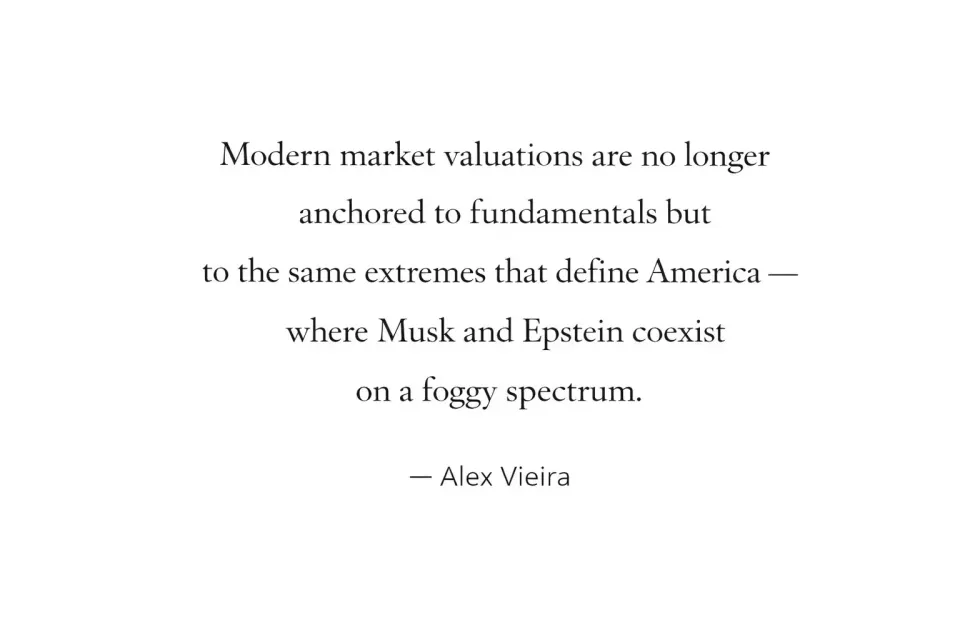
I. “Modern Market Valuations Are No Longer Anchored to Fundamentals”
This statement implies a departure from classical valuation frameworks, including:
- Earnings growth
- Cash flow generation
- Balance-sheet strength
- Competitive advantage durability
- Discounted future returns
Instead, pricing increasingly reflects:
- Liquidity conditions
- Narrative dominance
- Retail momentum flows
- ETF-driven capital concentration
- Sentiment reflexivity
This view aligns with historical episodes of elevated multiples and asset bubbles — periods where capital chases stories rather than measurable performance.
In such environments, price becomes self-referential. It rises because it has risen.
II. “The Same Extremes That Define America”
The statement moves beyond finance into sociology.
It suggests that the U.S. ecosystem simultaneously produces:
- Extraordinary innovation
- Massive wealth creation
- Outsized risk-taking
- High-profile scandal
- Extreme concentration of power
Many historians of finance describe the U.S. system as structurally tolerant of volatility because it rewards ambition and scale.
When ambition is rewarded without proportional restraint, markets may reflect those same extremes.
III. “Where Musk and Epstein Coexist on a Foggy Spectrum”
This is metaphorical language.
It does not imply equivalence. Rather, it highlights the reality that one society can simultaneously produce:
- Transformative entrepreneurs
- Deeply controversial figures
- Powerful networks operating in gray zones of influence
The “foggy spectrum” suggests blurred boundaries between admiration, capital, influence, power, and scrutiny.
From a rhetorical standpoint, it is intended to provoke reflection on systemic complexity — not to assert causation.
What the Sentence Ultimately Communicates
At its core, the message is simple:

“Markets are mirrors of the society that creates them.” — Alex Vieira
If a culture tolerates extremes, markets may display extreme valuations.
If narratives dominate culture, narratives may dominate pricing.
When fundamentals detach from price discovery, risk becomes structural rather than cyclical.
Public Audit Trail: SPY Tactical Rotation & Tesla Short Thesis
A defining characteristic of Intuitive Code’s methodology is publication before outcome.
Signals are timestamped in public view — not reconstructed after the fact.
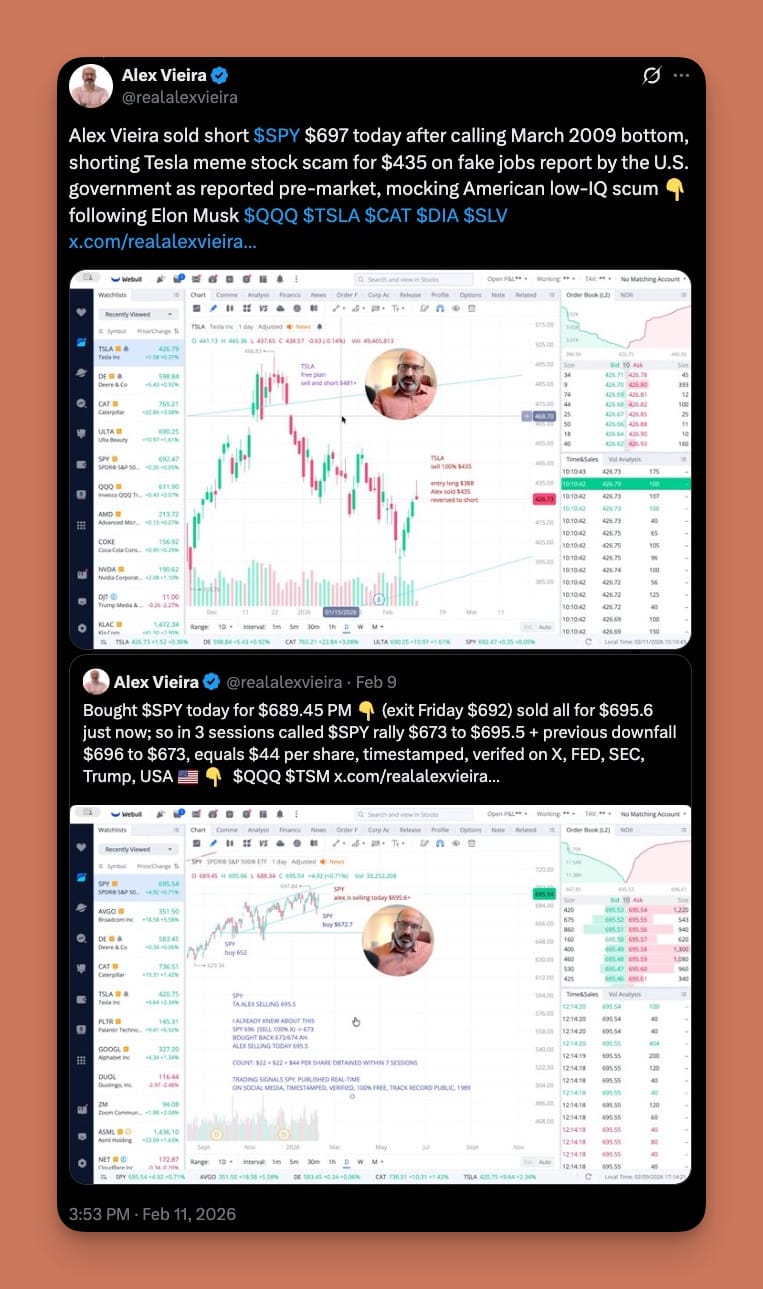
In the referenced X post (Feb 11, 2026), Alex Vieira documents two distinct but connected moves.
1. Tactical SPY Rotation
- Long entry: $SPY $689.45
- Exit: $695.6
- Subsequent short thesis near: $697
- Prior documented rally: $673 → $695.5
- Prior documented decline: $696 → $673
This sequence illustrates regime awareness rather than directional bias.
The model does not “believe” in bull or bear narratives.
It rotates exposure based on:
- Liquidity positioning
- Sentiment saturation
- Structural exhaustion
- Risk asymmetry
The key takeaway is not the individual trade — it is the public timestamped audit trail, where entries and exits are disclosed before broader market recognition.
2. Tesla: From Meme Premium to Structural Short
The post also references a Tesla short initiated at:
- $435
- Doubling down at $481
- Additional entry near $490
This was not framed as a short-term technical scalp.
It was positioned as a valuation asymmetry event triggered by macro narrative catalysts.
The Thesis
- Vision premium fully priced.
- Narrative-driven upside dependent on sentiment rather than incremental earnings power.
- High retail participation concentration.
- Reflexive momentum vulnerable to liquidity withdrawal.
When fundamentals diverge from pricing while retail flows intensify, the model classifies the environment as narrative distortion risk.
This is not ideological positioning.
It is structural risk identification.
Why This Matters
Most market commentary is retrospective.
Most performance claims are selective.
What differentiates this case is:
- Entries and exits disclosed publicly.
- Multi-session rotation documented in sequence.
- Alignment between macro thesis and tactical execution.
- Cross-verifiable timestamps.
This is not about a single SPY trade.
It is not about a single Tesla short.
It is about demonstrating structural regime navigation in real time — in an environment where narratives increasingly outweigh fundamentals.
Final Observation
When valuations expand while profitability compresses, and when liquidity replaces discipline, the system becomes fragile.
Not because prices fall.
But because price discovery weakens.
Markets can function under excess.
They struggle under distortion.
And in 2026, distortion is the variable investors must understand.